Metal business cards aren’t “a trend.” They’re a flex, and, used well, a surprisingly practical one.
Paper cards are polite. Digital contact swaps are efficient. Metal cards are memorable in a way people don’t forget by the time they reach the parking lot. And yes, that difference shows up later in replies, referrals, and who gets remembered when a decision-maker finally has budget.
One-line truth: people keep metal.
The real reason they work (it’s not just the shine)
Here’s the thing: networking isn’t about exchanging information. It’s about creating a moment, a tiny psychological anchor that makes someone recognize your name a week later without squinting at their inbox.
Metal cards do three things at once:
– They slow the interaction down. Recipients feel the weight, flip it over, run a thumb across the engraving (they just do).
– They signal intent. You didn’t print 500 flimsy rectangles because you had to. You chose permanence.
– They survive. Wallet friction, coffee spills, bent pockets, metal shrugs.
Now, this won’t apply to everyone, but… if your business depends on trust, precision, or high-value relationships, the medium is part of the message. That’s why metal business kards can change the tone of a first meeting, suddenly you’re not “one of the vendors,” you’re the person who looks established.
A quick stat, because vibes aren’t enough
Physical touchpoints tend to stick better than digital-only outreach. A widely cited benchmark from the Data & Marketing Association (DMA) puts direct mail response rates around 4.4% for prospect lists vs. ~0.12% for email (DMA Response Rate Report, often quoted in marketing summaries). A business card isn’t direct mail, obviously, but the principle carries: physical media can outperform digital on recall and response because it’s harder to ignore.
Metal just pushes that advantage further by being harder to discard.
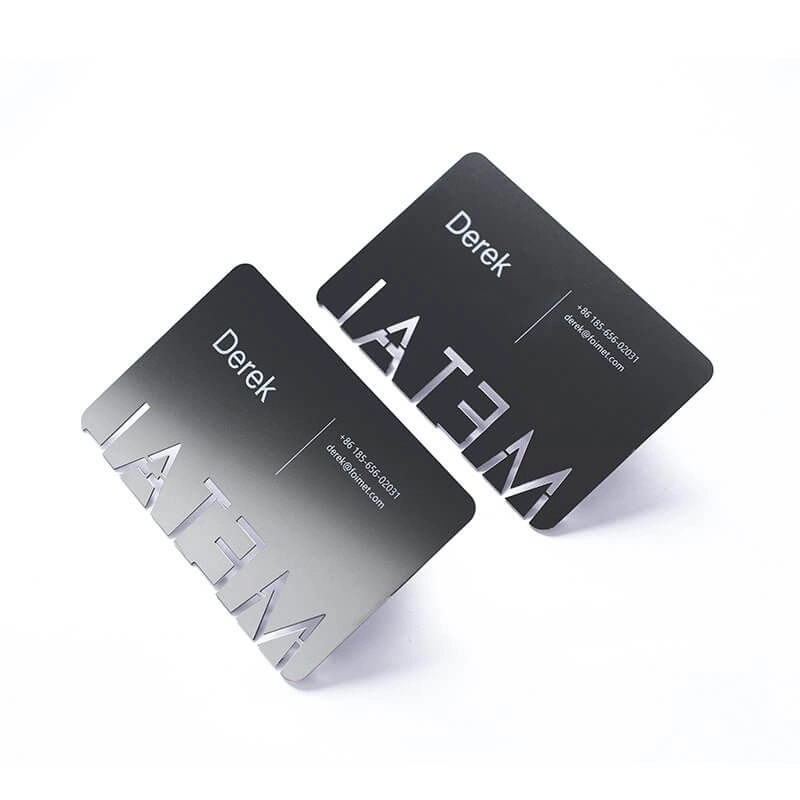
“Do metal cards fit my brand?” Ask yourself this, not that
Most people ask: Do I want to look premium?
Better question: Does premium help my buyer trust me faster?
If you sell something high-consideration, consulting, enterprise software, real estate, private wealth, bespoke manufacturing, metal often matches the psychology of the purchase. If you’re running a community nonprofit or a scrappy local service where warmth matters more than polish, metal can feel… try-hard (unless you design it with restraint).
A fast gut-check I use with clients:
– If your brand promise includes durability, longevity, safety, or precision, metal reinforces it.
– If your brand voice is casual, playful, anti-corporate, metal can still work, but the design must do the softening (rounded corners, matte finish, minimal gloss).
– If you need to hand out hundreds of cards at low-value events, you may be forcing the wrong tool into the wrong job.
And please: if your website looks dated, don’t “solve” that with a titanium card. People will notice the mismatch.
Materials & finishes (the nerdy part, but it matters)
You don’t pick metal cards the way you pick paper stock. You’re choosing how something will age in pockets, on desks, in card holders, and under fluorescent conference lighting.
Common materials, in plain language
Aluminum
Light, affordable, easy to color (anodizing). Scratches show sooner. Great for bold brand colors.
Stainless steel
Heavier, more “serious,” excellent wear resistance. If you want the this company will still exist in 10 years vibe, stainless does that.
Titanium
Expensive, strong, and slightly mythical in the buyer’s mind. In my experience, titanium is overkill unless your brand is already operating at that level. Otherwise you’re paying for a story you haven’t earned yet.
Finishes that actually affect usability
Brushed and matte finishes are often the best choice because they reduce glare and keep text readable. Polished looks dramatic, until you’re standing under ballroom lights and the card turns into a mirror.
Laser engraving tends to win for longevity. Ink and surface printing can look gorgeous, but wear patterns are real when people toss your card into a bag with keys.
One more thing (because people forget): rounded corners feel better in-hand and reduce edge chipping. Small detail. Big difference over a year.
Hot take: NFC is great, but don’t make it the whole point.
I like NFC metal cards. When they work, they’re frictionless.
When they don’t, you get an awkward little ritual: “Uh, do you have NFC on? Try unlocking. No, not like that…”
Use NFC as a bonus lane, not the only lane. The card still needs to function as a normal business card. Legible name. Clear role. A phone number that isn’t microscopic. QR code if it fits the design (and if it doesn’t, don’t force it).
If you do add a digital trigger, send people somewhere purposeful:
– vCard download (clean and fast)
– calendar booking link for qualified prospects
– a landing page tailored to the event or industry
Generic homepage links are the networking equivalent of “we should totally grab coffee sometime.” Nice. Pointless.
ROI: the only way to talk about cost without lying to yourself
Metal cards cost more upfront. That’s true.
The smarter comparison isn’t metal vs paper. It’s cost per meaningful follow-up.
If a $3, $8 metal card helps you land one extra meeting that turns into one extra client, the math stops being dramatic. On the other hand, if you hand out 200 cards at a crowded expo and nobody remembers who you are because your pitch was fuzzy, you just distributed expensive coasters.
I’d evaluate ROI with a simple tracking habit:
– How many cards handed out per event
– How many inbound mentions (“Hey, we met at…”)
– How many booked follow-ups tied to that event
– Close rate on those follow-ups
Look, attribution will never be perfect. But you’ll see patterns quickly.
Design rules that people break (and then wonder why the card “didn’t work”)
Metal punishes bad design. Paper forgives it.
A few guidelines I’d defend in an argument:
– High contrast wins. If the finish is dark, etch or fill light. If the finish is light, go deep and crisp.
– Fewer words. The card is not a brochure, and metal makes clutter feel louder.
– Don’t get cute with tiny type. Microtext looks clever in mockups and fails under real lighting.
– Two fonts max. More than that and you’re designing noise.
– Negative space is your friend. Especially with premium materials, empty space reads as confidence.
And test in real life. Not on a screen. Not in a render. In a lobby, in a restaurant, under bad lighting, where networking actually happens.
When metal cards shine (and when they don’t)
Metal cards are unfairly effective in a few scenarios:
Client meetings where trust is being evaluated in seconds.
Private events where everyone already has “nice” cards, so only the unusual stands out.
Industries where materiality signals competence, architecture, engineering, luxury services, high-end B2B.
They’re less effective when speed and volume matter more than impression. If you’re in a hyper-casual space, a thoughtfully designed thick paper card can beat metal by feeling more human.
Choosing a supplier: what I’d ask before I paid a cent
Don’t pick on photos alone. Everyone’s mockups look perfect.
Ask for samples. Then ask questions that reveal whether they can deliver consistently:
– What tolerances do you hold on thickness and corner finishing?
– How do you prevent batch-to-batch color shift on anodized cards?
– Is the engraving depth consistent across the run?
– What’s your reprint process if there’s a defect?
– Can you provide recycled metal options or coating specs (if sustainability is part of your brand story)?
If they dodge specifics, that’s your answer.
The peer-pressure factor is real
One last opinion, and I’ll stand by it: metal business cards are spreading because nobody wants to be the person handing out flimsy paper after receiving something that feels engineered.
That doesn’t mean you must follow. It means you should decide deliberately.
If your brand benefits from permanence, weight, and a little theater, metal cards aren’t just worth trying. They’re a competitive advantage you can literally put in someone’s hand.